
Held
Neuroadaptive Touch · Level 1
The body doesn't let go because you tell it to. It lets go because it finally feels safe.
Learn the method. Four weeks, live, founding cohort.
Neuroadaptive Touch · Level 1
Learn the method. Four weeks, live, founding cohort.
The practice
Neuroadaptive Touch is a practice of intentional, responsive touch designed to help create the conditions for safety, presence and nervous system regulation.
Rather than following a fixed sequence of techniques, you learn to listen through touch.
You learn how to notice subtle changes in someone's breathing, muscle tone, movement, stillness and responsiveness — and adapt your touch accordingly.
What's missing
Not safely. Not with skill. Not in a way that lets their nervous system actually receive it.
So we hover. We rush. We pat twice and let go. And the people closest to us — clients, partners, parents — go untouched in the way that matters most.
The body's most direct route to safety sits unused. Not because people don't care — because no one showed them how.

The method
In simple terms: the touch adapts to the person.
Most bodywork is built around a sequence. Neuroadaptive Touch is built around responsiveness.
Every nervous system is different. The same pressure, speed, movement or contact can feel completely different depending on someone's state, history and level of safety in that moment.
So instead of imposing a predetermined experience, you learn to pay attention to the signals the body is already giving you.
Over time, this can create a feedback loop: I feel something — you notice — you respond — I feel your response — my system has new information.
This is one of the foundations of co-regulation. Your nervous system doesn't exist in isolation. Human beings are constantly receiving information from one another through facial expression, voice, proximity, movement and touch.
When touch is slow, predictable, respectful and responsive, it can provide another source of information: You don't have to do anything right now. You are being met.
Neuroadaptive Touch works with this relational dimension of regulation. Not by forcing someone into a particular state. But by creating the conditions in which their system can potentially find its own way there.
The body responds differently when it feels met rather than managed.
Origin
Neuroadaptive Touch wasn't created as a technique to be performed on people.
It developed through years of working with the body, breath, nervous system and human connection — and through repeatedly witnessing what can happen when another person experiences a quality of presence that allows them to soften.
The method emerged from a simple observation: the body responds differently when it feels met rather than managed.
Over time, this became an exploration of how touch could become more responsive, less prescriptive and more attuned to the person receiving it.
Rather than asking "What technique should I do next?" — Neuroadaptive Touch asks: "What is happening here — and how can I meet it?"
The method has continued to evolve through thousands of hours of practice, sessions, teaching and working with people in different states and circumstances.
Today, Neuroadaptive Touch brings together principles of nervous system regulation, conscious touch, presence, breath, attunement and co-regulation into a practice that can be learned and embodied.
The teacher
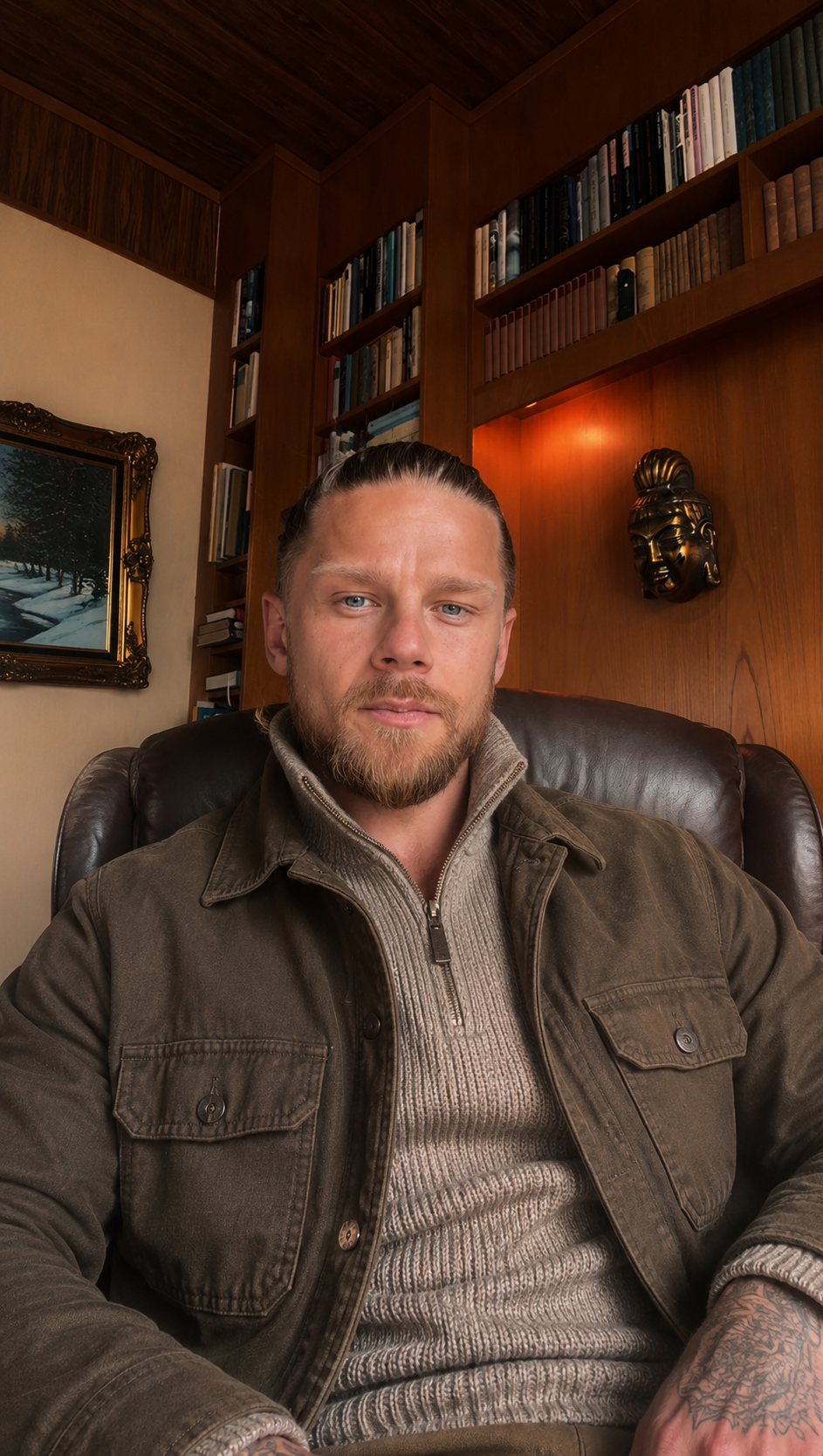
My work has always lived at the intersection of breath, the nervous system, the body and human connection.
My background includes breathwork, somatic practices, nervous-system education and working directly with people through transformational experiences.
But Neuroadaptive Touch didn't come from collecting certifications. It came from years of observing people. Learning to feel. Learning to slow down. Learning when to do less.
And learning that sometimes the most powerful thing you can offer another human being is not another technique — but your ability to genuinely be there.
What makes this different
Massage generally works with the physical body through pressure, movement and manipulation of tissue.
Neuroadaptive Touch is less concerned with doing something to the body and more concerned with creating a responsive relationship with the person inside it.
The intention isn't primarily to release a muscle, correct a structure or achieve a particular physical outcome. The intention is presence. Attunement. Responsiveness. Connection.
This doesn't make it "better" than massage. It's simply different.
There can certainly be overlap. Many practices work with presence, subtle sensation, touch, awareness or regulation.
What makes this practice distinct is the emphasis on adaptive relational touch — learning to continuously read and respond to the person rather than applying a fixed protocol or trying to produce a particular energetic, emotional or physical outcome.
You don't need to believe in a particular energetic framework to practice it. You don't need to diagnose someone. You don't need to "fix" them.
You learn to become more sensitive to what is happening between two nervous systems — and to respond with greater precision, presence and care.
And unlike a hug, this isn't simply about physical closeness. A hug can be incredibly regulating. But Neuroadaptive Touch teaches you how to become deliberate with the qualities that make touch feel safe, responsive and connected — including pressure, timing, stillness, movement, boundaries, attention and adaptation.
The experience
There isn't one correct response.
Someone might become deeply relaxed.
Someone else might become emotional.
Someone might laugh.
They might feel warmth, tingling or changes in their breathing.
They might become very still.
They might notice sensations they weren't aware of before.
Or they might simply feel… good.
Sometimes the experience is profound. Sometimes it is incredibly ordinary. And that's important.
The goal is not the release.
The goal is creating a relationship with the body in which whatever is happening can be met with enough safety and presence.
What shifts
People describe a wide range of experiences after receiving Neuroadaptive Touch.
Some describe feeling deeply relaxed or grounded.
Others describe feeling more connected to their body, more emotionally open or more present with another person.
Some experience tears or emotional movement.
Others notice changes in how they relate to touch, intimacy or connection.
And sometimes the change is much simpler:
"I finally felt like I could let go."
These experiences are deeply personal, and they aren't guaranteed. Neuroadaptive Touch isn't a promise of healing a particular condition or producing a particular emotional outcome. It's a practice that creates a different kind of environment for the nervous system — and the person — to experience themselves.
What people have said
I kept waiting for him to do something. Press harder, move, adjust. He just stayed. And at some point my whole body started shaking and I realised I'd been holding my breath for what felt like years.— Lina M., somatic therapist, Stockholm
I practised on my partner the same night. She looked at me afterwards and said "what did you just do?" I didn't do anything. I just stayed. That was the whole point.— Daniel R., breathwork facilitator, Berlin
For the first time in my life I felt like I didn't have to explain what was happening in my body. Someone was just there. That was enough.— Sara K., yoga teacher, London
Sometimes healing doesn't begin when someone finally changes. Sometimes it begins when they finally feel like they don't have to.
The curriculum
Understand what is happening beneath the surface of human connection. Explore polyvagal theory, neuroception, autonomic states, fight/flight, shutdown and social engagement, and why the nervous system can respond to perceived threat before we consciously understand why. Learn how touch deprivation affects regulation and connection, how co-regulation works, and the three foundational principles of Neuroadaptive Touch.
Learn how to create the conditions where the nervous system can actually feel safe enough to soften. Go deeply into consent, boundaries, trauma-awareness, contraindications and practitioner scope — including when not to touch. Learn to distinguish between supporting regulation and trying to control someone's experience, and how to stay grounded, ethical and responsive throughout the work.
Learn the Neuroadaptive Touch protocol from beginning to end. Develop the ability to enter contact slowly, establish safety, titrate sensation, read subtle nervous-system cues and adapt your touch in real time. Explore pressure, pacing, rhythm, stillness, positioning and withdrawal — and learn how to recognize when to stay, when to change, and when to let go. Finish with closing and aftercare so the experience can be integrated rather than simply interrupted.
Move from understanding into embodied skill. Practice the Hold with supervision and learn how to respond when someone's nervous system activates, freezes, disconnects or becomes overwhelmed. Develop your capacity for presence and co-regulation while learning how to stay within your scope. Finally, learn how to bring Neuroadaptive Touch into your existing practice, relationships and everyday life — without turning it into another technique to perform.
The format
This isn't a course where you sit in front of a screen and watch someone demonstrate techniques for hours. You learn by experiencing.
Understanding the principles behind Neuroadaptive Touch, the nervous system, touch, regulation, consent and relational safety.
Seeing the principles translated into actual touch and interaction.
Learning through doing — receiving touch yourself and practicing with others.
Understanding what you noticed, what changed and why.
Bringing the practice into your own way of working and relating.
Space to ask questions, troubleshoot experiences and deepen your understanding.
You can't learn relational touch entirely from a slide deck. You have to experience it.

What you'll be able to do
Level 1 is designed to give you the foundational skills and understanding needed to begin practicing Neuroadaptive Touch safely and intentionally.
Level 1 is not about turning you into a therapist. It does not qualify you to diagnose, treat or manage mental-health conditions.
It gives you the foundation to practice the method within the scope of your training and experience.
If you want to work professionally with clients, additional training, appropriate professional boundaries, insurance and/or relevant qualifications may be required depending on where and how you practice.
The practice space
You don't need a fancy studio. You don't need expensive equipment. You don't even necessarily need a massage table.
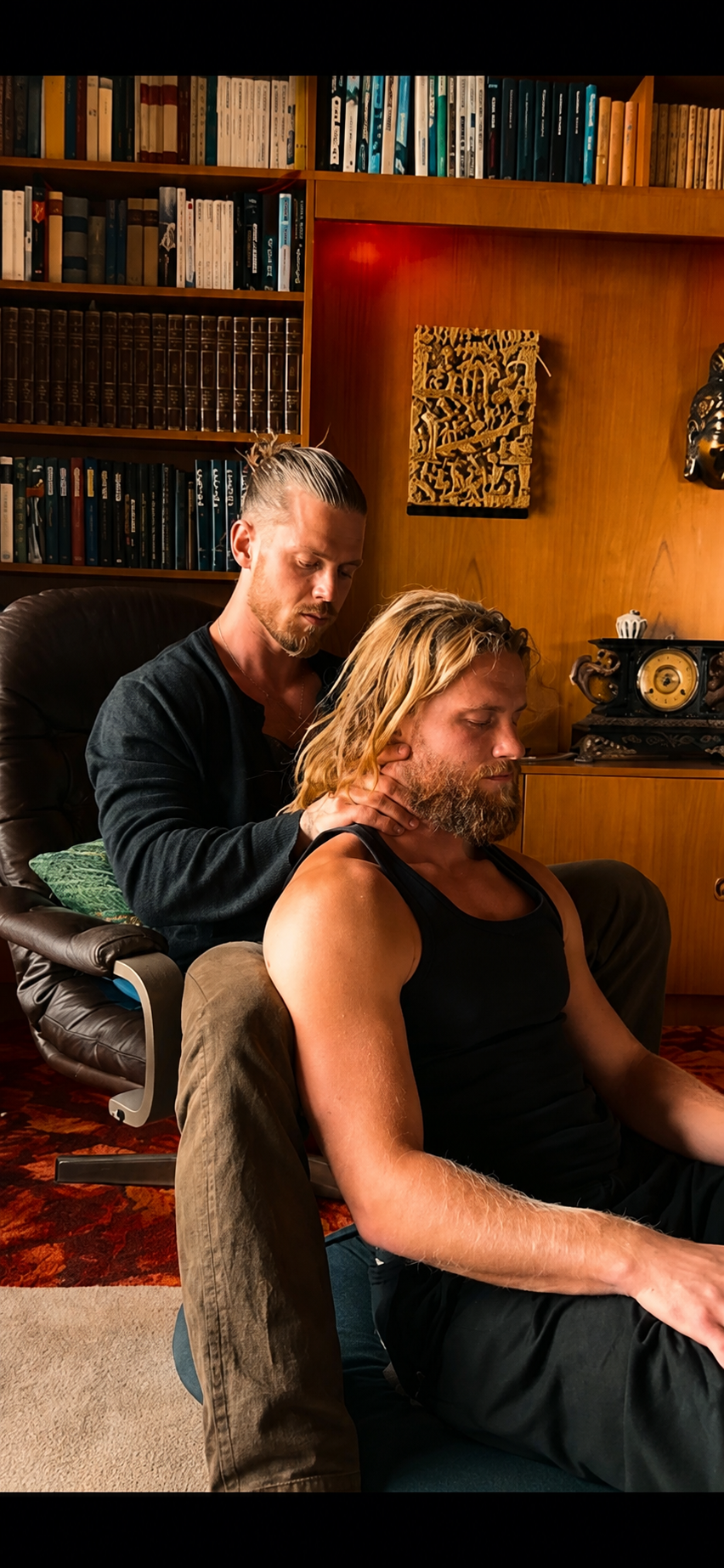
Neuroadaptive Touch can be practiced on a couch, bed, floor or other comfortable surface, depending on the practice.
What you need most is space to slow down, enough privacy to feel present, and another person who has explicitly agreed to practice with you.
The goal isn't to recreate a spa environment. It's to learn how to create presence wherever you are.
When and where
Level 1 is currently delivered online, allowing you to learn the principles, experience the work and practice with people from wherever you are.
Because Neuroadaptive Touch is experiential, the online format includes guided partner practices and breakout work rather than simply watching demonstrations.
You don't need to be in the same physical room as the teacher to begin learning the principles. You do, however, need a practice partner for the experiential components.
Every Sunday at 19:00 CET
Four consecutive weeks
Total weekly commitment is approximately 4 hours, including the live session, homework, reading material and personal practice.
The practice develops through repetition. Through receiving. Through giving. Through noticing. Through doing it again.
Everything you get
Who this is for
Bodyworkers and manual therapists · breathwork, yoga and somatic teachers · coaches and therapists · nurses and carers · and partners, parents and friends who want to bring this home.
Who it isn't for
If you're here to receive holding rather than learn to offer it, this isn't the right room — my free content will serve you far better.
Next cohort
Leave your name and email and you'll be the first to know when doors open for the next cohort.
No commitment · just first access when doors open
Safety
This is an important question.
You don't need to be "fully healed" before learning Neuroadaptive Touch. In fact, learning to notice your own responses can become an important part of learning to be present with someone else's.
But this work asks for self-awareness.
If practicing or receiving touch brings up strong emotions, memories or nervous-system responses, the answer isn't to push through them. You slow down. You pause. You communicate. You create space. And you seek appropriate support when something goes beyond the scope of the training.
Neuroadaptive Touch is not trauma therapy, and the training does not ask students to process their personal trauma through the practice. You are never required to disclose personal experiences to participate.
Your boundaries are part of the practice.
You don't need to panic. And you don't need to immediately interpret what is happening.
A person crying doesn't automatically mean they've "released trauma." Shaking doesn't automatically mean trauma is leaving the body. Freezing doesn't automatically mean something is wrong.
Your first job is presence.
Slow down.
Notice.
Check in.
Ask what they need.
Respect their response.
And be willing to stop.
Students are taught how to respond to emotional and physiological reactions without turning themselves into therapists or trying to explain someone's experience for them.
The goal isn't to manage another person's nervous system. It's to learn how to remain grounded, respectful and responsive while another person experiences their own.
Sometimes the most skillful intervention is more touch. Sometimes it's less. Sometimes it's removing the touch completely. Knowing the difference is part of the practice.
The philosophy
This might be the most important thing to understand about Neuroadaptive Touch.
You are not learning how to fix another person's nervous system. You are learning how to meet another person with enough presence that they don't have to perform, explain or change what they're experiencing.
There is no perfect nervous-system state you are trying to create. No emotional release you need to produce. No experience you need to manufacture.
Instead, you learn to listen.
To respond.
To stay.
And to let the person in front of you have their own experience.
Because sometimes healing doesn't begin when someone finally changes. Sometimes it begins when they finally feel like they don't have to.
Why I'm teaching this
I can't hold everyone. The only way this reaches the people who need it is through other pairs of hands.
Questions
No. Level 1 assumes no prior training. You need to want to hold someone well — whether that's a client or your own father.
No. Neuroadaptive Touch is entirely non-sexual, and the consent and boundary work is a core part of the training, not an afterthought.
That's fine. You'll have self-practice options and paired practice within the cohort. You do need a practice partner for the experiential components — the training will help you find one if needed.
Every session is recorded, and you can send questions ahead of time. But the live practice and breakout work is where most of the learning happens — attend live if you can.
It's a certificate of completion for Level 1 of the method — not an external accreditation. Further levels will follow.
That's exactly what week two and the titration work are for. Knowing when not to touch is part of the skill. You'll learn how to slow down, pause and communicate before anything goes further than it should.
Level 1 gives you the foundation. Whether you can use it professionally depends on your existing qualifications, where you practice, and what scope of work you're doing. The training addresses this directly.
Level 1 is delivered live online. The format includes guided partner practices and breakout work — it's not just watching a screen. In-person intensives may follow in future cohorts.
Not ready yet?
A free class on Neuroadaptive Touch — what it is, why it works, and a practice you can try right after. No commitment. Just come curious.
Watch nowFree · 45 minutes · watch anytime
Be first to know when the next cohort opens